
Introduction
Upper body calisthenics has become one of the most popular ways to build genuine strength and muscle without stepping into a gym, relying entirely on bodyweight movements that scale from complete beginner to advanced athlete. This article breaks down a complete upper body calisthenics workout, the core movement categories it should include, and how to progress as you get stronger.
Why Calisthenics Works for Upper Body Development
Calisthenics builds strength through compound, multi-joint movements that recruit multiple muscle groups simultaneously, closely mirroring functional movement patterns rather than isolating individual muscles the way many machine exercises do. Because bodyweight exercises can be progressively made harder through leverage changes, tempo adjustments, or more advanced variations, rather than requiring added external weight, calisthenics offers a genuinely scalable path from beginner to advanced strength levels using nothing but your own body.
The Push Movement Category
Push exercises target the chest, shoulders, and triceps. Standard push-ups form the foundation, and can be scaled easier with knee push-ups or incline push-ups (hands elevated on a bench or step), or harder with decline push-ups (feet elevated), diamond push-ups (hands close together, emphasizing triceps), or eventually archer push-ups and one-arm push-up progressions for advanced trainees. Pike push-ups, performed with hips raised in an inverted-V position, shift emphasis toward the shoulders and serve as a stepping stone toward handstand push-ups for more advanced calisthenics practitioners.
The Pull Movement Category
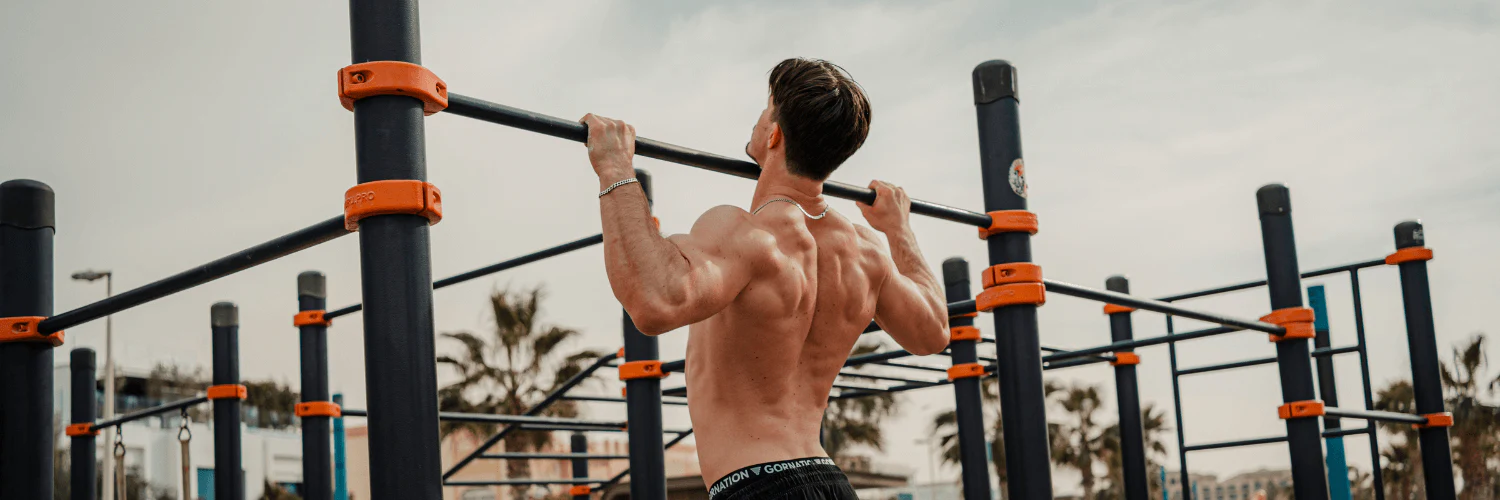
Pull exercises target the back, biceps, and rear shoulders, and are generally the hardest upper body calisthenics category to progress in without equipment, since most pull movements require something to grip and pull against. Pull-ups and chin-ups on a bar are the gold standard, targeting the lats, upper back, and biceps. For those without access to a pull-up bar, inverted rows, using a low bar, sturdy table edge, or suspension trainer, allow a horizontal pulling motion that still meaningfully trains the same muscle groups, and can be scaled easier or harder by adjusting body angle.
The Core and Stabilization Category
While often categorized separately, core work is essential to upper body calisthenics since most advanced movements require significant core stability to execute properly. Planks, hollow body holds, and leg raises build the foundational core strength needed for more advanced skills like the front lever or handstand work. This category also directly supports better performance and injury prevention in the push and pull categories.
A Sample Full Upper Body Calisthenics Workout
A balanced session might include: push-ups (3 sets to near failure), pull-ups or inverted rows (3 sets to near failure), pike push-ups (3 sets of 8-12 reps), dips using a chair or sturdy furniture (3 sets of 8-12 reps, targeting triceps and chest), and a core finisher like plank holds or hollow body holds (3 sets, 30-60 seconds). Resting 60-90 seconds between sets allows adequate recovery while keeping the session efficient, typically 30-45 minutes total.
Progressive Overload Without Weights
The core principle behind continued strength gains in calisthenics is progressive overload, gradually making exercises harder over time, just achieved differently than with weights. This can mean increasing reps or sets, slowing down the tempo of each rep to increase time under tension, moving to a more difficult exercise variation (like progressing from knee push-ups to standard push-ups to decline push-ups), or reducing rest time between sets to increase overall training density.
Common Mistakes in Upper Body Calisthenics
A few mistakes show up frequently among beginners. Rushing through reps with poor form, particularly in push-ups and pull-ups, reduces the effectiveness of the movement and increases injury risk; slowing down and focusing on full range of motion matters more than speed. Neglecting the pull category in favor of push exercises, since push-ups are more accessible than pull-ups for beginners, is another common imbalance that can lead to poor posture and shoulder issues over time if not addressed directly.
Progressing Toward Advanced Calisthenics Skills
Once foundational strength is built across the push, pull, and core categories, more advanced calisthenics skills become accessible: muscle-ups, front and back levers, handstand push-ups, and one-arm push-up progressions all build on the foundational strength developed through consistent basic training. These advanced skills generally require months to years of consistent foundational work, making patience and consistency more important than rushing toward advanced movements before the basics are solid.
Conclusion
An effective upper body calisthenics workout combines push, pull, and core movements in a balanced routine that can be done anywhere with no equipment required. Focusing on proper form, progressively increasing difficulty over time, and maintaining balance between push and pull movements builds genuine, functional upper body strength that scales from complete beginner to advanced athlete using nothing but bodyweight training.